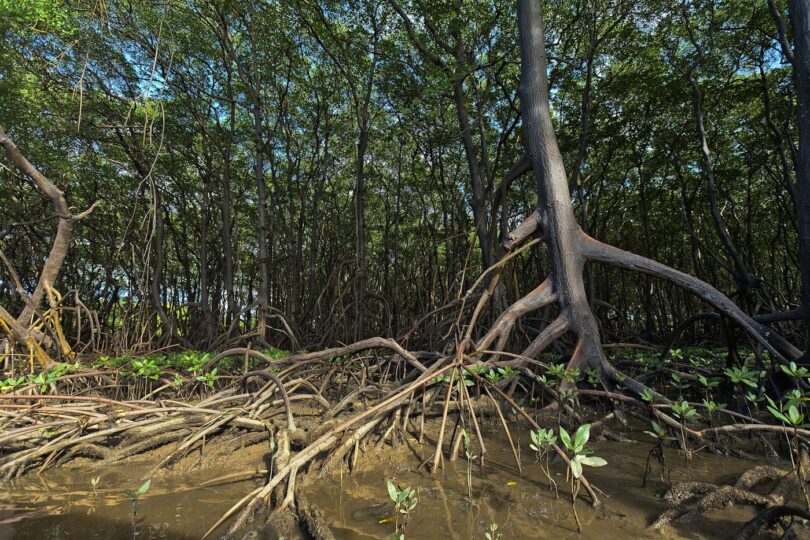

Along tropical and subtropical coasts, a dense wall of trees grows where the sea meets the land, rooted in salty mud and flooded twice a day by the tide. These are mangrove forests, and they are among the most useful ecosystems on Earth. Their tangled roots slow the water that rushes in with a storm surge, so waves lose their force before they reach homes, roads and farmland. Studies have found that a wide belt of mangroves can cut the height of storm waves dramatically, and during cyclones the forests have saved lives and property in places where the trees were left standing. The same roots trap silt and shelter young fish, crabs and shrimp, making mangroves a nursery for the fisheries that coastal families depend on.
What the Evidence Shows
Mangroves also store carbon at an extraordinary rate. Their waterlogged soils hold carbon for centuries, and a single hectare can store several times more than the same area of tropical rainforest. Yet mangroves are disappearing fast, cleared for shrimp ponds, palm oil, ports and coastal building, with large areas lost in recent decades. Restoration projects are now planting mangroves across Asia, Africa and Latin America, and they work best when local people are involved, since the trees need the right mix of fresh and salt water and the right species in the right place. Protecting the forests that remain is cheaper than rebuilding after a storm, and for millions of people who live behind them, the tangled roots are the first and best line of defence. Reporting and analysis from sources such as BBC News track the same developments, and specialists following the mangrove forests shielding coastlines from storm surges say the direction is now consistent across independent lines of evidence.
The Wider Context
The wider context is a public conversation conducted at a speed institutions were not built for. Developments around the mangrove forests shielding coastlines from storm surges are announced, contested and revised within a single news cycle, and the officials involved have learned to publish evidence alongside claims so that scrutiny can actually occur. Trust, the polling suggests, follows that transparency more than it follows confidence.
What Happens Next
What happens next in the story of the mangrove forests shielding coastlines from storm surges will be decided in the places where it is being implemented, measured and argued about in public. The officials and organisations involved have committed to publishing progress data, and that commitment gives residents, businesses and journalists something firmer than promises to judge. The next milestones are dated, which means they can be checked. You can follow related developments in our coverage of news.
None of this will be settled by a single announcement, study or product launch. The pattern to watch is accumulation: independent confirmations, honest reporting of failures and steady improvement in the underlying numbers. Readers who follow those signals, rather than the loudest claim of the week, will understand this subject better than most of the commentary surrounding it suggests is possible.