
Importers evaluating a custom food packaging manufacturer may start with a product photograph and target price. The harder questions come later: Is an existing mold close enough? Will the lid suit the filling process? Can the structure be reproduced for repeat orders? A factory’s value becomes clearer between the initial inquiry and approved production.
Quick Answer: An effective OEM food packaging project begins with a clear application brief. The manufacturer should review existing tools first, evaluate whether a modification is feasible and propose new tooling only when necessary. Physical samples, a written specification and production planning should be approved before bulk orders are released.
1. A Catalog Does Not Show the Full Manufacturing Capability
Two suppliers may display similar clear containers online while operating very differently. One may offer only a fixed set of trading-stock items. Another may have factory resources to assess dimensions, tool changes, closure designs and repeat production requirements.
A standard-clamshell buyer may prioritize replenishment; a new food brand may need a different footprint, lid or compartment arrangement.
For an OEM project, the starting question is not simply “Can you make this?” It is “Which parts of this design are already proven, and which would need development and testing?”
2. Why an Existing Mold Library Matters
An existing mold is a manufacturing asset, not just another catalog entry. It can represent a previously developed footprint, lid profile, hinge, height or container shape that a buyer can review before paying for entirely new tooling.
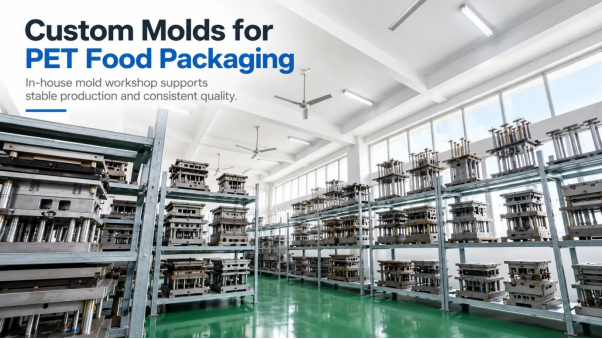
One example is YIHAO® Packaging, a thermoformed food-packaging manufacturer in Fujian, China. Its published custom food packaging mold solutions describe a library of more than 500 existing molds, in-house design support and its own mold equipment. For an importer, the practical benefit is the ability to compare established options with the requested product before committing to a new tool.
Mold count alone is not decisive. Buyers must verify the chosen tool’s dimensions, material and closure; an existing mold is not automatically available or approved for their use.
3. Existing Mold, Modified Mold or New Tooling?
There are three broad development routes. The factory should explain what can be reused, what must be changed and what requires a new design.
| Development route | When it may be appropriate | Buyer approval needed |
| Existing mold | Standard format closely matches the intended food and dimensions | Current product sample, lid fit and written specification |
| Modified mold | A feasible adjustment to height, detail or closure may meet the requirement | Feasibility review, revised drawings, samples and cost impact |
| New custom mold | Unique geometry, opening system or application cannot be met with available tools | Design brief, tooling quote, ownership terms, milestones and final samples |
An apparently minor change can affect forming, trimming or closure and may require new tooling.
4. Design for the Food, the Filling Line and the Shelf
The best packaging drawings describe more than external appearance. A factory needs enough information to evaluate what happens when the container is filled, closed, moved and displayed.
For a bakery pack, the lid height must clear the actual cake. For a berry clamshell, the vent arrangement and base support should suit the fruit and cooling process. For a tamper-evident food container, the designated opening feature should be assessed separately from leak resistance. A PET cup project depends on the exact cup rim and matching lid profile.
Translate those requirements into testable dimensions. Changes in footprint, lid height or locks can affect stacking, carton volume and filling operations.
A manufacturing-oriented review identifies those interactions before a buyer commits to tooling.
5. Sample Approval Is the Bridge Between Design and Production
A rendering is not a production reference. Buyers need a physical sample and written acceptance criteria.
A practical sample process includes:
- Confirming the model or drawing revision used to make the sample.
- Filling the pack with the actual food or beverage at the intended weight or level.
- Checking hinges, lids, locking points, vents and other molded details.
- Testing realistic handling, stacking and transport conditions.
- Reviewing the material and any required food-contact documentation for that specific product.
- Recording accepted dimensions, appearance, packing method and reference samples.
New structures may require more than one sampling round. Document revisions and obtain buyer approval before production. A defined custom food packaging development process can help buyers and manufacturers keep drawings, physical samples, approval records and production requirements aligned throughout the project.
6. Supporting Different Food Packaging Categories
Produce clamshells, bakery packs, deli containers, cups, sushi trays and tamper-evident boxes share forming principles but require different tools and checks.
An importer with several customers may want multiple established models. A brand may need a custom variant of only one product. In either situation, a clear model list helps separate existing products from those awaiting sample or tooling approval.
For cup projects, the rim and matching lid should be treated as a defined pair. For separate-base-and-lid trays, both components require review. Matching nominal lid diameters do not establish compatibility across unrelated molds or manufacturers without physical fit testing.
7. What Factory-Based Project Coordination Looks Like
YIHAO® describes a development workflow that moves from requirement and mold review through design evaluation, sample testing and mass production. For a buyer, the useful checkpoints are:
- Requirement review: Confirm food use, intended dimensions, material, quantities and destination market.
- Mold assessment: Check current products, feasible modifications and any need for new tooling.
- Design review: Agree the critical dimensions, closure details and expected performance checks.
- Sample approval: Evaluate the physical sample and sign off the accepted revision.
- Production planning: Confirm material, tooling readiness, quality checkpoints and order schedule.
- Packing and export: Approve carton specifications, marks and shipping requirements.
Ask who owns each approval and how changes are communicated. After sample approval, reviewing a manufacturer’s PET food packaging factory overview can help buyers understand how thermoforming, quality inspection and export packing support the transition from tooling to repeat production.
8. Tooling Cost Is Only One Part of the Quotation
A tooling price means little without the associated production terms. Similar-sized packs can differ in material use, closure complexity and carton configuration.
Buyers should compare the commercial basis of the proposals, including tooling charges where applicable, minimum production quantities, sample approval, packing quantity, production lead time and agreed shipping term. For shipments quoted FOB, the named port should be stated, such as FOB Xiamen when that is the agreed departure port.
If a manufacturer supports several SKUs within one container shipment, the order should identify quantities and cartons by model. A mixed-SKU option does not eliminate minimum-order requirements; the overall container requirement and any SKU-level conditions must be confirmed before the order is placed.
Lead times depend on approved samples, materials and scheduling.
9. Evidence Worth Asking a Custom Packaging Factory to Show
Ask the factory specific questions:
- Can the supplier show comparable existing products and explain their main dimensional differences?
- Is the proposed mold already in service, a modification or a new tool?
- Who reviews drawings, lid fit, stacking and sample revisions?
- What is the procedure for approving the final sample before mass production?
- How are mold and specification revisions controlled for future orders?
- Which product-specific material records and inspection documents are available?
- How are carton configurations and export marks confirmed before shipment?
A factory’s answers should be specific to the proposed product. Broad claims about equipment or certifications are less useful if the buyer cannot establish which records relate to the actual order.
10. Frequently Asked Questions
Does every OEM food container require a new mold?
No. An existing mold may meet the requirements, and some changes may be feasible through modification. New tooling is appropriate when the desired structure cannot be achieved with available options.
Is having hundreds of molds enough to prove customization capability?
No. A mold library is useful, but project assessment, design support, sampling, process control and repeat-production records are also important.
Can a manufacturer use a buyer’s existing sample as a reference?
Often it can review the physical sample, photographs or drawings, subject to technical feasibility and any relevant intellectual-property permissions. The final design should still be confirmed through an approved specification.
Can PET cold cups and their lids be developed separately?
They are separate components, but rim geometry and lid fit must be assessed together. A similar nominal diameter does not guarantee compatibility.
Should importers approve a mold design or a finished sample?
Both play a role. The design defines the intended structure; the physical sample confirms how the finished product behaves with its actual contents and handling conditions.
Conclusion
An OEM food packaging manufacturer is most useful when it can help a buyer make informed decisions between existing products, feasible changes and new development. Mold resources can reduce unnecessary design work, but reliable execution still depends on clear specifications, sample approval and disciplined production handover. Together, these controls help importers approve practical, repeatable packaging.