
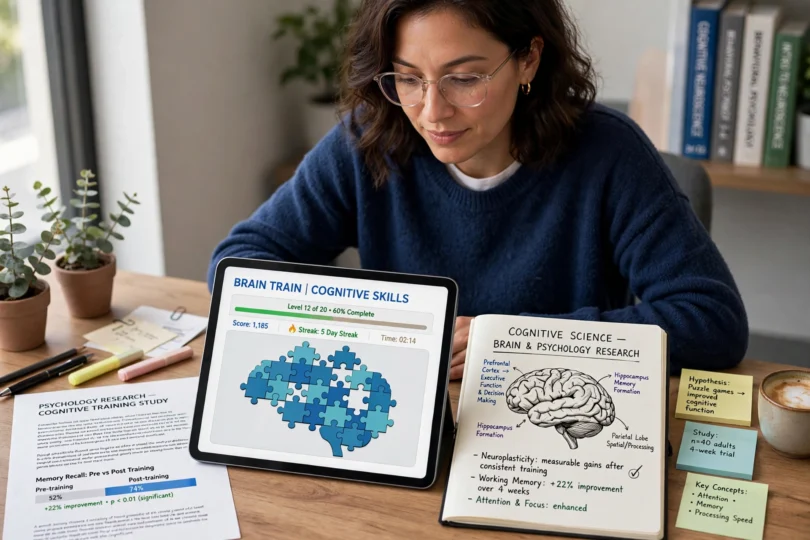

Brain-training apps promise a lot in a small download: sharper memory, faster thinking, better focus at work and even protection against age-related decline. Millions of people play them daily, from word puzzles and memory grids to speed-matching games designed by neuroscience-branded companies. The question psychologists keep asking is simpler, and harder to market: do you get better at anything except the game itself?
The evidence, after two decades of studies, is more nuanced than either the adverts or the sceptics suggest. Brain games can help with specific skills, and they can be enjoyable, motivating and even useful as a daily routine. What they have not convincingly shown is a broad transfer to everyday intelligence. Related coverage of games and digital habits appears in our report on how gaming companies can build visibility through useful publishing.
What the Studies Actually Found
Early research created excitement because participants who practised a task for weeks did improve — sometimes dramatically. Later, larger and better-controlled trials asked whether those gains transferred. In many cases, people got better at the trained game, somewhat better at very similar tests, and little or no better at unrelated reasoning, memory in daily life or attention at work.
Reviews by psychological associations and independent researchers have reached a similar conclusion: claims that commercial brain games prevent dementia or generally raise intelligence go well beyond the data. Regulators have previously acted against companies for overstating benefits, and scientists now insist on active control groups — comparing a brain game not with doing nothing, but with another engaging activity such as watching educational videos or doing crosswords.
That distinction matters. When the comparison group is also mentally active, the special advantage of expensive brain-training programmes often shrinks.
Why Improvement Feels So Real
Players are not imagining their progress. Scores rise, levels unlock and reaction times fall. The brain is genuinely learning — strategies, patterns and the rules of that particular game. Psychologists call this near transfer, and it is a normal part of skill learning, just as practising chess openings makes you better at chess openings.
Far transfer is the difficult part. Remembering a sequence of flashing squares does not automatically help you remember a shopping list, follow a complex meeting or resist distraction on your phone. The mind is not a single muscle that grows uniformly whenever it is exercised; it is a set of systems, and training one routine does not strengthen them all equally.
Expectation also plays a role. If people believe a programme will help, they may test themselves more confidently afterwards, a placebo-like effect researchers must carefully control.
Where Brain Games May Still Help
None of this makes the games worthless. For some older adults, structured cognitive exercises supervised by clinicians can support rehabilitation after injury or stroke, though that is medical therapy, not a consumer app subscription. For healthy adults, games can provide mental stimulation, structure and enjoyment — all worthwhile, provided the claims stay honest.
Certain types of training show more promise. Speed-of-processing exercises in some large trials were linked with modest benefits for everyday functioning in older adults, and dual-task or physical-plus-cognitive programmes are an active area of research. Scientists also value games as research tools, because they can measure attention and memory precisely over time.
Guidance from bodies such as the National Institute on Aging emphasises the broader picture for brain health rather than any single product.
What Works Better, According to Evidence
If the goal is long-term cognition, the strongest evidence supports unglamorous habits. Regular aerobic exercise improves blood flow to the brain and is linked with better memory and executive function. Good sleep consolidates learning. Treating hearing loss, managing blood pressure and diabetes, and staying socially and intellectually engaged are all associated with lower risk of decline.
Learning a genuinely new, complex skill — a language, a musical instrument, or a demanding new role — may challenge the brain more broadly than repeating a familiar mini-game, a point also made in Harvard Health’s overview to train your brain. Reading, volunteering and varied social activity add novelty and motivation, which simple repetitive tasks often lack.
Nutrition and not smoking matter too, not because any single food is a brain booster, but because vascular health and brain health are closely connected.
How to Use Brain Games Sensibly
Enjoy them as games first. Choose apps that are clear about what they train, avoid those promising to prevent disease, and do not let a subscription replace exercise, sleep or medical advice. Set a time limit, vary the activities, and notice whether benefits show up where it counts — at work, in study or in daily life, not only on a leaderboard.
For parents, the same rule applies to children: puzzles can support practice and confidence, but they are no substitute for reading together, physical play, sleep and school engagement.
The Bottom Line
Are brain games effective? Yes, at making you better at brain games, and sometimes at closely related tasks. As a general upgrade for cognition, the science remains unconvincing. Treat them as one enjoyable piece of a much larger, better-proven lifestyle — move more, sleep well, learn new things and stay connected — and their place in a healthy routine becomes both clearer and more realistic.