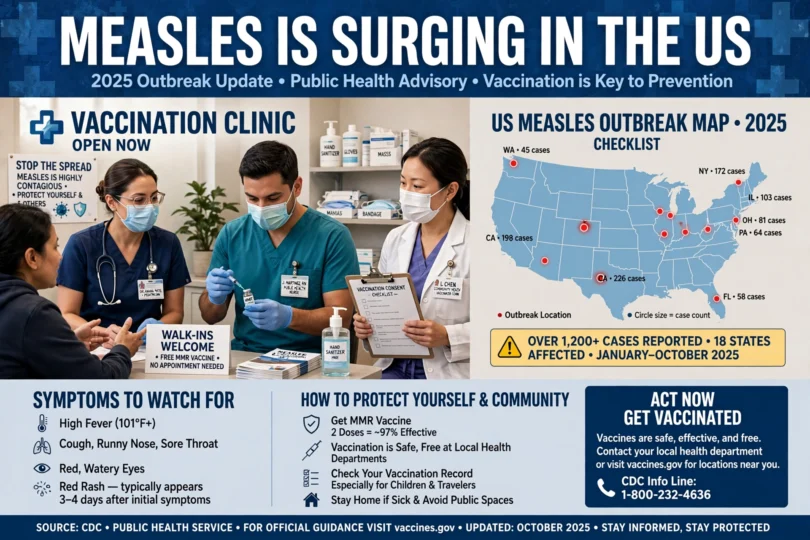

Measles was declared eliminated in the United States in 2000, a milestone built on decades of routine childhood vaccination. That achievement is now under strain. Cases have climbed sharply, outbreaks have spread across multiple states, and public health officials warn that the country is seeing the kind of sustained transmission not seen in a generation. Graphics tracking case counts, hospitalisations and vaccination coverage tell a stark story: a highly preventable disease is finding the gaps left by falling immunisation rates.
The resurgence matters not only because measles can be severe, but because it is a warning sign. Where measles returns, other vaccine-preventable diseases often follow, and the communities hit hardest are usually those where access to care, trust in official advice, or both have already weakened. For more coverage of health and science issues, readers can start from the News Packets homepage.
How Bad Has It Gotten?
National tallies compiled by the Centers for Disease Control and Prevention show a clear pattern. Instead of isolated cases in travellers returning from abroad, health departments are now reporting clusters linked to schools, childcare centres and close-knit communities where vaccination coverage is well below the national average. Many patients are children who were eligible for the measles, mumps and rubella vaccine but had not received both doses.
The illness itself is unforgiving. Measles spreads through the air and can linger in a room long after an infected person has left. Early symptoms look like a heavy cold — fever, cough, red eyes and a runny nose — followed by a distinctive rash. Complications can include pneumonia, ear infections, dehydration and, in rare cases, inflammation of the brain. Infants too young to be vaccinated, pregnant people and those with weakened immune systems face the greatest risk.
Hospital data underline the point. A significant share of recent cases have required hospital care, not because every infection becomes critical, but because measles weakens the immune system and leaves patients vulnerable to secondary infections in the weeks that follow.
Why Vaccination Gaps Are Driving the Surge
Public health experts point to a simple threshold. To stop measles spreading, about 95 percent of a community needs to be immune. National coverage for kindergarten children has slipped below that level, and in some local pockets it is far lower. When coverage falls even a few points, the maths changes quickly, because measles is one of the most contagious viruses known.
Several forces have combined. Routine appointments missed during the pandemic were not always caught up. Misinformation online has made some parents hesitant, often exaggerating rare vaccine side effects while understating the risks of the disease itself. In other places the problem is practical rather than ideological: clinic hours, transport, cost confusion and a shortage of local providers can all delay a second dose.
The World Health Organization notes the same pattern globally — measles rises first where systems falter, long before it appears in national headlines.
Where Outbreaks Are Hitting Hardest
Outbreaks have not been evenly spread. States and counties with lower MMR coverage, larger exemption rates or recent disruptions to school health requirements have seen the biggest clusters. Once a case reaches an under-vaccinated school or community gathering, contact tracing becomes difficult, because exposed people may have been infectious days before the rash appeared.
Local officials have responded with familiar tools: exclusion of unvaccinated students during outbreaks, free catch-up clinics, mobile vaccination units and direct outreach in languages spoken locally. Those measures can contain a cluster, but they work best early, before chains of transmission become untraceable.
What Officials Advise Now
The advice from doctors has not changed, because the vaccine has not changed. Two doses of MMR are about 97 percent effective against measles, and serious reactions are rare. Parents unsure of a child’s status are urged to check records with their clinician or school nurse and to catch up before travel, summer camps or the new school term.
Adults should also check. People born before routine two-dose schedules, health workers and international travellers may need a booster or a documented dose. Anyone who develops fever and rash after possible exposure should call ahead before visiting a clinic, so staff can isolate them quickly and protect other patients.
Finally, officials stress calm verification over viral claims. A single misleading post can travel faster than a virus. Checking case numbers with state health departments, asking a trusted clinician direct questions and looking at coverage maps for your own county give a far clearer picture than social media graphics shared without context.
The Bottom Line
Measles is surging not because medicine lacks an answer, but because the answer is not reaching everyone evenly. Closing small local gaps — a missed second dose here, an unvaccinated classroom there — is what turns a national resurgence back into rare, contained cases. The graphics may show how bad it has gotten, but coverage charts also show the way out.