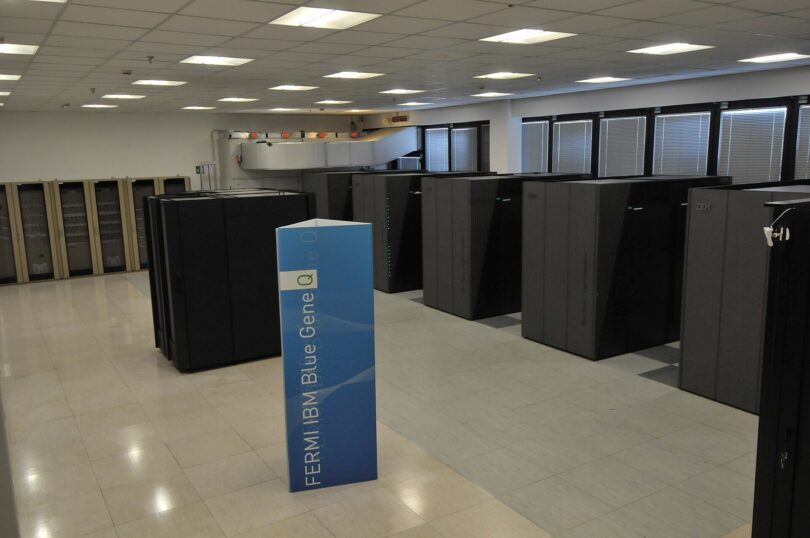

Europe’s first exascale supercomputer, JUPITER, housed at Forschungszentrum Juelich in Germany, has been used by NVIDIA researchers to run the largest comprehensive simulation of a fault-tolerant quantum computer yet attempted: a virtual machine of 104 qubits, complete with the error correction that real quantum hardware struggles to sustain. On paper it is a benchmarking story. In practice, it may matter most in an unlikely place: the pharmaceutical laboratory.
Quantum computers promise to model molecules exactly as nature does, rather than through the approximations classical machines are forced to make. The catch is that today’s quantum processors are noisy and small, so researchers simulate them on classical supercomputers to design algorithms and error-correction schemes long before the hardware matures. Each additional simulated qubit doubles the memory required, which is why an exascale machine — capable of a quintillion calculations per second — changes what can be tested, as our technology coverage has been tracking.
Why Simulate a Machine That Does Not Exist Yet?
Fault tolerance is the threshold quantum computing must cross to become useful. A fault-tolerant machine detects and corrects its own errors as it calculates, and designing those correction codes is largely a software problem that can be explored in simulation. Running a 104-qubit fault-tolerant design end-to-end lets researchers measure how error rates scale, where the bottlenecks sit, and which architectures deserve billions in hardware investment.
The JUPITER run is therefore best read as a map-making exercise. It tells the field which roads are worth paving. Classical simulation will eventually hit a wall — somewhere beyond 50 or 60 qubits of full state simulation, memory demands become astronomical — but error-corrected logical qubits behave differently from raw physical ones, and exascale machines extend the frontier of what can be verified rather than merely hoped for.
The Pharmaceutical Prize
Drug discovery is the application most often cited by quantum optimists, and for good reason. Simulating how a candidate molecule binds to a protein is a quantum-mechanical problem at its core; classical approximations can mislead chemists for years. Even modest improvements in predicting binding behaviour could shorten the decade-long, billion-dollar path from compound to clinic, a prospect that has drawn sustained investment from the pharmaceutical industry, according to background published by Nature.
Nobody credible claims a quantum-designed drug is imminent. What the JUPITER result signals is pace: the simulation infrastructure around quantum computing is maturing as fast as the processors themselves. Hybrid workflows, in which exascale classical machines and small quantum devices check each other’s work, are likely to produce the first genuinely useful results in chemistry years before a fully fault-tolerant quantum computer exists.
Europe’s Bet on Sovereign Computing
There is also a geopolitical layer. JUPITER was procured by the EuroHPC Joint Undertaking as a statement that Europe intends to own a meaningful share of the world’s most powerful computing infrastructure rather than rent it. Its modular, energy-conscious design — the machine has topped efficiency rankings — reflects an argument that exascale capacity is becoming as strategic as semiconductor supply.
A New Kind of Scientific Instrument
There is a pattern in the history of computing: each generation’s flagship machine redefines what questions are askable. JUPITER’s significance may prove less about any single result than about the queue forming behind it — materials scientists modelling battery chemistries atom by atom, fusion researchers simulating plasma behaviour that experiments cannot yet reach, climate teams running ensembles at resolutions that resolve storms rather than approximate them. The machine’s first year will be judged by the science it enables others to publish.
That queue is also a policy instrument. Access to Europe’s flagship is allocated competitively to research teams across the continent, which makes exascale time a currency of scientific prestige — and a reason for talent to stay. Supercomputers have always been about the calculations. They have also always been about the people the calculations attract.
For now, the headline remains the simulation itself: 104 qubits, fault-tolerant, verified on Europe’s flagship machine. The molecules will come later, but the path from this kind of run to a shorter drug pipeline is clearer than it has ever been. More coverage of the quantum race is available from newspackets.com.