
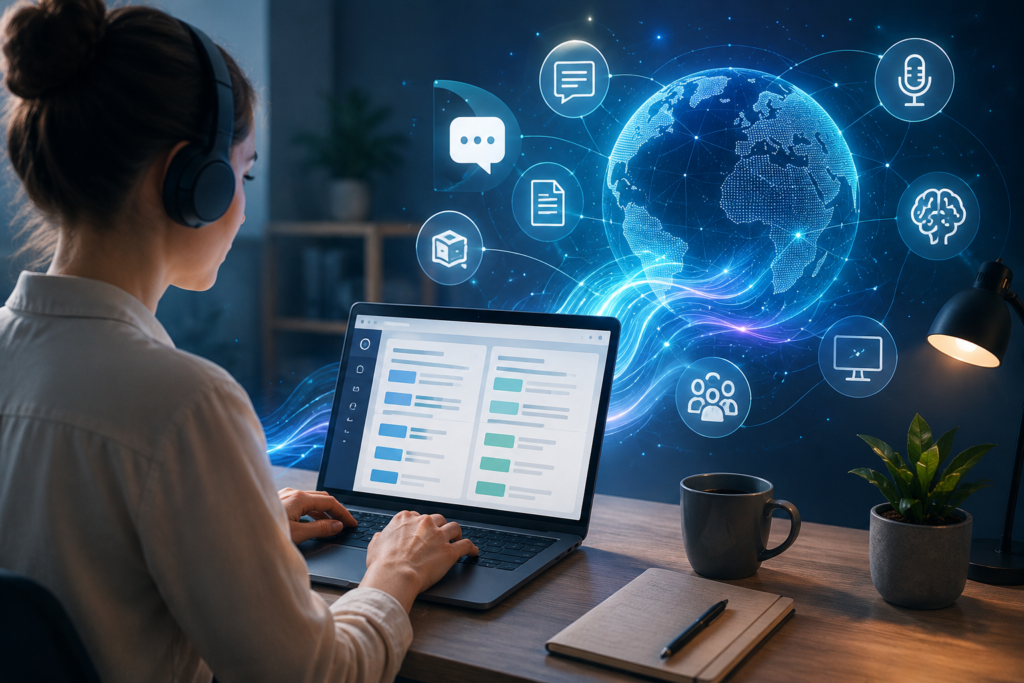
For most of human history, translation was a slow, solitary craft. A linguist would sit with a stack of paper, a stack of dictionaries, and a stack of patience, moving meaning from one language into another at a pace measured in pages per day. The translator was the bottleneck, the safeguard, and the artisan all at once. That picture has changed almost beyond recognition. Today’s professional linguists work inside layered digital environments where memory, terminology, machine learning, and human judgment converge on the same sentence at the same time. The result is not a profession in decline, as some feared a decade ago, but a profession dramatically accelerated. Modern translators routinely produce twice as many words per day as their predecessors did in the early 2000s, and they do so without a measurable drop in quality. Understanding how that happened, and where the next leap is coming from, is essential for anyone building products, services, or content for a multilingual world.
From Typewriters to Translation Environments
The first revolution was simply the move from paper to screen, but the second, and far more important, was the appearance of the translation memory. A translation memory is a database that stores every sentence a translator has ever rendered, paired with its source. The next time a similar sentence appears, the system surfaces the previous translation, ranks it by similarity, and lets the linguist accept, edit, or reject it. The economics of this are obvious. In any technical domain – software, legal, medical, marketing – the same phrases recur constantly. “Click here to continue,” “subject to the terms of this agreement,” “consult your physician before use.” A linguist who had to retype these thousands of times each year now confirms them in seconds.
Around the translation memory, an entire ecosystem of tools matured. Termbases enforce that a single product name, slogan, or regulated term is rendered identically across every document. Quality assurance modules flag inconsistent numbers, missing tags, double spaces, and forgotten placeholders before a file is ever delivered. Segmentation rules break long documents into manageable units. Concordance search lets a translator query their own past work for the way a tricky phrase was previously handled. Each of these features sounds modest in isolation, but together they turn the act of translation from a linear performance into something closer to programming: a structured, searchable, version-controlled activity in which every keystroke compounds the value of the previous one.
The Quiet Power of CAT Tools
The umbrella term for this category is computer-assisted translation, and the software that provides it is universally referred to in the industry as CAT software. Almost every large language service provider on the planet has standardized on these environments, because the productivity gains are too significant to ignore. A well-configured workspace using mature cat tools translation workflows can lift a linguist’s daily throughput from roughly 2,000 words to 4,000 or more, while simultaneously improving consistency scores on quality audits. The reason is not that the tool is doing the translation; it is that the tool is removing every form of friction that surrounded translation before. Search is instant. Reference is one click away. Repetitive content is recognized automatically. Terminology is enforced as the linguist types. The translator’s cognitive budget, which used to be spent on logistics, is now spent almost entirely on linguistic judgment.
This shift matters for quality as much as for speed. When a translator no longer has to remember whether “user” was rendered “пользователь” or “клиент” three months ago in chapter four, they can focus on the harder question of whether the current sentence reads naturally to a native speaker. Tools handle the bookkeeping. Humans handle the meaning. That division of labor is the central insight of the modern translation environment, and it is what allows scale and craft to coexist.
The Arrival of AI as a Real Coworker
Translation memory taught the industry to value reuse. Neural machine translation, which became commercially viable around 2017 and has improved every year since, taught it to value augmentation. Modern neural systems do not produce the laughable word-salad of early statistical machine translation. For high-resource language pairs and well-defined domains, raw machine output is now coherent, grammatical, and often quite close to the final published version. The linguist’s role has therefore shifted from translator to post-editor: reviewing, correcting, and elevating machine output rather than producing every word from scratch.
The productivity implications are striking. Industry studies repeatedly show that machine translation post-editing, when integrated properly into a CAT environment, yields throughput gains of 60 to 100 percent over traditional translation, depending on language pair and content type. Quality, when measured by independent reviewers against the same rubrics used for human-only translation, is statistically indistinguishable in many domains, and demonstrably better in domains where the machine has been fine-tuned on customer-specific data. The translator becomes a curator of meaning rather than its sole producer.
The newest generation of large language models has pushed this even further. Where neural machine translation produced a single best guess for each sentence, modern AI assistants can explain their reasoning, propose multiple variants tuned for different registers, generate glossary suggestions from a single document, summarize style guides, and even draft localization briefs. A translator working with an AI copilot can ask, in plain language, why a particular phrase was rendered the way it was, request an alternative that sounds less formal, or have the system check whether a candidate translation is consistent with five hundred previously approved segments. These are tasks that would have required hours of manual work a decade ago. They now happen in conversational time.
Automation Beyond the Sentence
The doubling of linguist productivity is not only a matter of better suggestions inside the editor. A vast amount of efficiency gain comes from automating everything that surrounds the editor. In a modern localization pipeline, source content moves from a content management system to the translation environment without anyone copying and pasting. File formats are parsed automatically, with translatable text exposed and non-translatable code protected. Tags, variables, and placeholders are preserved and validated. When the translation is complete, the localized file flows back into the source system, often triggering automated builds, test runs, and deployments.
This kind of integration changes the nature of the work. A translator no longer waits days for a project manager to email a file, then days more for it to be reviewed, then days more for it to reach the developer who will paste it into the application. Continuous localization means strings appear in the workspace within minutes of being written by the source-language author and reach end users within hours of being approved. The bottleneck, which used to be the translator, has effectively been redistributed across the pipeline, and the pipeline itself has been streamlined to the point where translation can keep pace with software releases that ship daily.
Quality assurance has been transformed in the same way. Automated checks catch the kind of errors that used to slip through human review: a number changed by a typo, a punctuation mark missing in a language that requires it, a date format that violates regional conventions, a string that exceeds the character limit of the user interface that will display it. These checks run automatically on every change, like unit tests in software development. Human reviewers are then free to spend their attention on the things only humans can judge: tone, cultural fit, persuasiveness, brand voice.
Crowdin as a Modern Localization Platform
A useful illustration of how all these strands come together in practice is Crowdin, a cloud-based localization platform widely used by software companies, game studios, and content publishers. Crowdin combines the editor experience of a CAT tool with the project orchestration of a continuous-integration system and the assistance of multiple AI engines, all in a single browser-based environment. Translators work inside a familiar segmented editor with translation memory and terminology support, while project managers configure automated workflows that pull source content from connected repositories, route segments to the right linguists, run quality checks, and publish approved translations back to production systems. AI suggestions, machine translation pretranslation, glossary extraction, and contextual screenshots are available to every team member without separate installations or licenses. The platform also supports collaborative review, with comments, voting, and version history attached to every segment, so distributed teams can resolve linguistic questions without leaving the workspace. The point is not that Crowdin is unique in offering any single one of these capabilities, but that the combination – automation, collaboration, and AI in one place – is what a contemporary localization operation looks like, and what allows a small team to manage what once required an entire department.
What “Without Losing Quality” Really Means
It is tempting to assume that any technology that doubles productivity must, somewhere, be cutting corners. The evidence from the last decade does not support that assumption, but it does change the definition of quality. In the older model, quality was something a single translator produced through individual care, and it was measured at delivery. In the modern model, quality is something a system produces through layered safeguards, and it is measured continuously.
A modern localization platform enforces glossary terms automatically, so a brand name cannot be mistranslated even if a tired linguist would have made the slip. Translation memory ensures that a sentence translated correctly once will be translated the same way next time, eliminating the consistency drift that used to plague long projects with rotating teams. Automated checks catch mechanical errors before they reach a reviewer. Machine suggestions, properly tuned, often produce a stronger first draft than a junior linguist working under deadline pressure. Senior reviewers can spend their time on the high-value editing that genuinely requires human judgment, rather than on repetitive corrections.
The result is a quality curve that is not only higher on average but also far more stable. Outliers – the bad day, the rushed project, the unfamiliar domain – are caught and corrected by the system before they become customer-facing problems. Quality, in other words, has become an emergent property of the workflow, not just an attribute of the individual translator.
The Translator’s Evolving Role
It would be wrong to read all of this as the displacement of human linguists. What the data actually shows is the elevation of the linguist’s work. The mechanical, repetitive, and logistical parts of translation have been progressively automated. What remains is harder, more interesting, and more valuable: cultural adaptation, transcreation, voice, persuasion, register, the navigation of legal and ethical nuance, the judgment calls that no model can make on its own.
Linguists who have embraced these tools report a different kind of working life. They handle more projects, in more domains, for more clients, while spending less time on tasks they always disliked. They develop new specializations: prompt engineering for translation, customization of machine translation engines, terminology architecture, localization quality engineering. The job title “translator” increasingly coexists with titles like “localization specialist,” “language engineer,” and “linguistic AI trainer,” each of which would have been unthinkable a generation ago.
Looking Forward
The trajectory is clear, and the next few years will accelerate it. Real-time multimodal translation, where text, voice, video, and images are localized in a single integrated workflow, is moving from research prototype to production reality. Personalization, where a system learns the preferences of an individual reader or audience and adapts the translation accordingly, is becoming feasible at scale. Domain-specific AI agents, fine-tuned on a single company’s content and capable of handling routine translation autonomously while escalating ambiguous cases to humans, are already being piloted by large enterprises.
The constant, across all of these developments, is the same partnership that has driven the last decade of progress. Machines handle volume, consistency, and speed. Humans handle meaning, nuance, and trust. The platforms that succeed are the ones that make this partnership effortless, that put the right capability in front of the linguist at the right moment, that automate the boring and amplify the creative. Translation, in this sense, has not been replaced by technology. It has been rebuilt around it. And the linguists who work inside that rebuilt profession, doubling their output without compromising their craft, are the clearest possible answer to the question of what the future of translation looks like in the digital age. It is faster, smarter, more collaborative, and unmistakably still human at its core.