
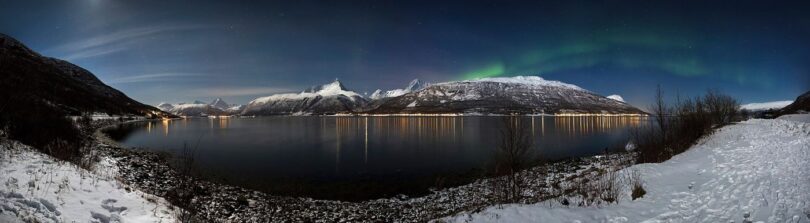

A powerful burst of charged particles from the Sun has painted skies far beyond the polar regions with ribbons of green, pink and purple light, giving millions of people an unexpected view of the aurora. Space weather forecasters say the storm ranks among the strongest of the current solar cycle, and further displays remain possible while the Sun stays in its most active phase. For many first-time watchers, the spectacle was also a reminder that our star shapes everyday life on Earth in ways that are usually invisible.
Why the Lights Reached So Far South
When the Sun releases a coronal mass ejection, clouds of electrified gas travel through space and can collide with Earth’s magnetic field a day or two later. That collision funnels particles toward the poles, where they excite oxygen and nitrogen in the upper atmosphere and release light. During a severe storm the glowing oval expands, which is why cameras in mid-latitude cities captured colours normally reserved for Arctic skies. Researchers at NASA note that the colours reveal altitude: green glows lower down, while rare reds form high above.
Forecasters stress that predicting an aurora precisely is still difficult. Satellites closer to the Sun give only a short warning before particles arrive, and local cloud cover decides who actually sees anything. Even so, modern alerts shared through our science coverage helped watchers plan trips to dark locations away from street lights, where even a modest display becomes vivid to the naked eye and spectacular in long-exposure photographs.
Beauty With a Technical Edge
Strong geomagnetic storms are not only beautiful. They can disturb radio communications, nudge satellite orbits, affect precision navigation and, in extreme cases, stress power grids. Operators therefore watch the same forecasts as photographers, moving satellites into safer modes and preparing for voltage fluctuations. This week’s event caused mostly minor effects, which experts describe in explainers from BBC Science, but it served as a useful rehearsal for grid and satellite teams.
Scientists expect the Sun to remain restless into next year before activity slowly declines. That means more chances to see the aurora, and more reason to improve forecasting models that combine solar images with real-time particle measurements. For the public, the advice is simple: watch the alerts, find dark skies, dress warmly and look north. A storm that once would have passed unnoticed now becomes a shared global moment, connecting backyard observers with the physics of a star 150 million kilometres away.
Amateur photographers have become an essential part of the modern aurora story, sharing real-time reports that help scientists map exactly where the glowing oval reached on any given night. Their observations, combined with satellite measurements, refine the models used to warn power-grid and satellite operators before the next storm arrives from the Sun.
Historians note that great aurora storms have long shaped human imagination, inspiring myths, diaries and early scientific expeditions. Today the same events are measured by instruments in space and on the ground, turning wonder into data. That combination of beauty and evidence is why solar storms remain one of the most watched stories in modern astronomy, drawing new audiences to science every time the sky lights up unexpectedly.